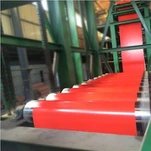
BilenHot Dip Galvalume Steel Coil enheten fokuserar på tillverkning av ytterplåtar. Tjockleken på produktspecifikationerna är oftast mellan 0,6 och 1,2 mm, plattans bredd är oftast 800 till 1850 mm, och den bredaste kan nå 2000 mm. Produktnivån är ganska komplex, från CQ, DQ, DDQ, EDDQ (IF) till BH, DP, TRIP och andra höghållfasta stålplåtar för fordon. Med hjälp av en mängd avancerade teknologier kan beläggningens morfologi och tjockleksnoggrannhet kontrolleras noggrant, till exempel att beläggningens tjockleksfel är mindre än 23g/m2. Dessutom kan den zinkfria-stålplåten framställas genom att använda bly{11}}fri galvanisering. Denna typ av beläggning är inte lätt att producera intergranulär korrosion och har en lång livslängd. Därför är den lämplig för bil- och elektriska apparater industrier. Nästan alla varmförzinkningsenheter-i Japan är utrustade med en ugn för zink-järnlegering. Standardtjockleken för galvaniserat lager av den zink-järnlegerade plattan (Galavneal) är 160180g/m2 på båda sidor, och legeringsbeläggningen innehåller Fe8 procent 12 procent 2.
Foreign countries developed micro-alloy steel and phosphorous alloy steel in the 1970s, bidirectional DP steel and bake hardening steel in the mid-1980s, and phase transformation and induced plasticity TRIP steel in the 1990s 3. At present, the international cooperation project "Ultra-Lightweight Steel Carbody (ULSAB) Development" is proceeding smoothly. Its goal is to achieve a driving fuel consumption of 34KM/3L (US) and a car bodyweight reduction of 25 percent . The primary starting point is to adopt many high-strength and ultra-high-strength steel plates in the car body structure. The most prominent feature of the ultra-light steel car body through the large ULSAB is that it does not sacrifice performance to reduce the car's weight 4. The design basis of ultra-light steel vehicles is that the proportion of high-strength steel used in the body structure exceeds 90 percent . During the ten years from 1985 to 1995, high-strength steel in the body increased from 10 percent to 30 percent . With the surface treatment performance, The improvement of automobile life span extends from 6.7 years to 9.3 years. After deducting the energy increase in the manufacture of high-performance steel plates, 357104L of heavy oil can save a year, which is almost equivalent to saving a percentage of the energy consumption of the domestic steel industry. A few. In 2000, the use of high-strength steel plates in Japanese automobile manufacturing reached 36.3 percent .